Working Missouri and Illinois Clay Soil: Why Compact Track Loaders Outperform Skid Steers
3/13/2026
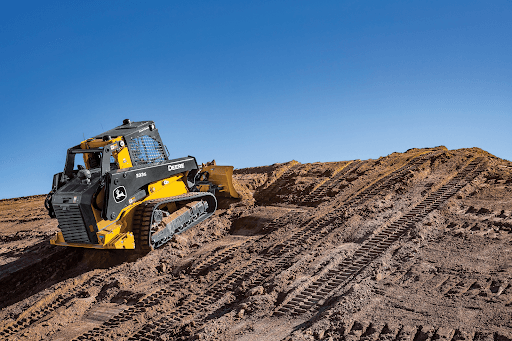
There is lots of potential for new developments in the Midwest, but the abundant clay soil can present challenges for contractors and landscapers starting new projects. Clay soil can be difficult to work with due to its extremely dense particles. It can become slick and unstable when wet, making equipment susceptible to rutting, and concrete hard when dry, making it prone to compaction. Working in these conditions requires a specific type of equipment that’s as stable as it is powerful. When it comes to compact construction equipment, Compact Track Loaders are the solution.
The key distinction between skid steers and compact track loaders is their design. Skid steers have a four-wheel design that steers by varying wheel speed on either side. They also have lighter weight distribution, making them more suitable for hard surfaces, indoor work, and paved areas.
Compact track loaders, on the other hand, have tracks instead of wheels. They have a similar steering mechanism, but greater weight distribution over surface areas.
Whether wet or dry, compact track loaders maintain traction in both wet and dry conditions. The track tread design powers through wet soil, driving mud away from drive components and maintaining forward momentum where wheels would spin out. When clay hardens, tracks provide enough bite to navigate dry clay effectively, maintaining control on slopes and even surfaces.
Site preparation, residential development, and agricultural construction all require heavy loads and force to get the job done. Compact track loaders were built for heavy-duty jobs, with strong pushing power and lift capacity. Their wider footprint helps them remain steady when lifting big loads reducing the risk of tipping even on uneven terrain. Consistent traction also makes them ideal for grading operations like land clearing and prep.
Soft surfaces like clay soil are more vulnerable to compaction, making low ground disturbance essential for successful site prep. Compact track loaders have a lower ground pressure than skid steers, making them less susceptible to rutting and more capable of preserving soil integrity for landscaping projects. This means cleaner jobsites with minimal track marks and easier final grading.
You can experience year-round productivity with a compact track loader. CTLs handle Missouri and Illinois mud seasons and winter freezes without losing traction or productivity. This allows contractors to bid projects year-round with confidence, increasing cash flow and competitive advantage.
Q: Can a compact track loader work on dry, hardened clay soil or just wet conditions?
A: Yes — CTLs perform well on both wet and dry clay. When clay hardens, the track tread provides enough grip to maintain traction and control on slopes, whereas wheels tend to slip on the smooth, compacted surface. The lower ground pressure also helps prevent the additional compaction that can make dry clay even harder to rework later.
Q: Do compact track loaders damage turf or finished areas near a jobsite?
A: CTLs cause significantly less surface damage than skid steers because their rubber tracks distribute weight across a larger contact area (3-5 PSI vs. 10-15+ PSI for wheeled machines). This makes them a better choice for work near established landscaping, finished grades, or areas where surface preservation matters.
Q: When does a skid steer make more sense than a CTL on a Missouri or Illinois jobsite?
A: Skid steers are the better choice for work on hard, stable surfaces — concrete, asphalt, compacted gravel, or indoor projects. They're also lower cost to own and maintain. If your work stays on solid ground and doesn't involve clay soil, wet conditions, or uneven terrain, a skid steer will serve you well. For mixed-conditions sites or any project involving Missouri/Illinois clay, the CTL's traction advantage typically justifies the price difference.
If you plan on tackling this fine Midwest soil for any upcoming projects, a compact track loader can make the job much easier. When you choose tracks, you get superior traction, heavy-duty capability, and all-season reliability. Reach out to your nearest Sydenstricker Nobbe Partners to talk to an expert about finding the right match for your operation. With locations across Missouri and Illinois, our team is ready to assist at every stage of ownership, from selection to service.